
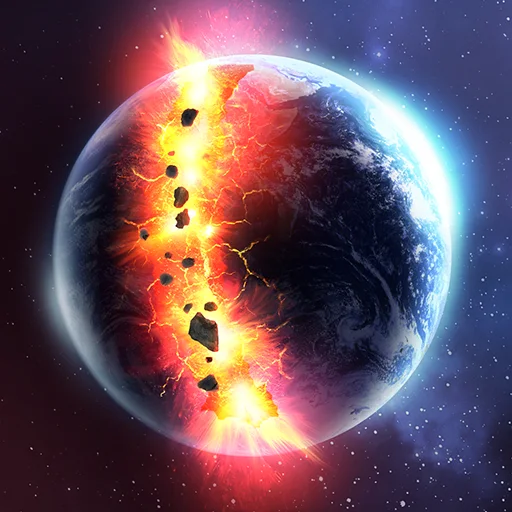
Solar Smash
4.6
- Category
- Simulation
- Platform
- Android
- Rating
- 4.6 / 5
- Installs
- 100M+
- Age
- Everyone 10+
- Developer
- Paradyme Games
- Updated
- Sep 17, 2026
- Size
- Varies by device
Game Description
Source: Google Play. Checked 2026-10-24. Store-user rating, not an OOZGM test score. Availability and pricing can change.
Solar Smash lets you experiment with planets and star systems using a broad collection of destructive and constructive tools. The official listing separates Planet Smash, which focuses on individual worlds, from Solar System Smash, where planets and their orbits can be arranged and disrupted. These modes offer different scales for the same curiosity: what happens when you change this part of the scene?
There is no need to approach it as a conventional campaign with a single winning route. You can choose a visual experiment, observe it and reset for another version. The developer uses scientific language to describe the simulation, but this guide has not validated its physical accuracy. Treat the results as game behavior rather than evidence for a real astronomical calculation.
Official external links. OOZGM does not host game files or APKs. Check device compatibility and current price before installing.
Screenshots
Images supplied by the developer through the official store listing.
Recommended Games











How To Play
- Choose Planet Smash for a single world or Solar System Smash for a broader orbital setup, then inspect the available controls.
- Apply one tool or change to a simple scene and watch the result before introducing additional effects.
- Reset or recreate the starting arrangement, change one relevant choice and compare the two outcomes.
Before you install
A good fit: Players who like open-ended visual experiments and inventing small questions for a sandbox to answer.
Consider: Flashing effects are an explicit developer warning. The simulation is entertainment; its results should not be presented as verified astronomy or engineering evidence.
Make one change visible
Begin with a relatively simple setup and use a single tool. Watch what happens to the targeted area and the surrounding scene before adding another effect. If everything is triggered at once, the result may be dramatic but difficult to interpret. A quieter first experiment gives the next one a clear comparison.
In the system mode, a useful question is how changing one body affects the arrangement around it. Keep the starting configuration similar between attempts so the difference remains understandable. Predict a result before making the change, then compare that prediction with what the game displays. The exercise can be enjoyable without assuming that the simulation supplies a complete scientific model.
Decide whether spectacle is enough
A sandbox gives freedom but asks the player to create reasons to continue. Someone who enjoys setting up visual experiments may find plenty to revisit. A player who needs a story, carefully graded levels or a competitive target may find the same menus aimless. Try both scales of play before judging the experience solely by a particularly dramatic destruction effect.
The listing explicitly warns about flashing lights and photosensitive conditions. Take that presentation warning into account before starting, especially on a shared screen. For ordinary sessions, choose a small set of experiments and stop when they are complete. Collecting every possible effect is not necessary to enjoy discovering how a particular tool changes a familiar scene.
Original OOZGM editorial analysis · AI-assisted and based on official listing evidence; no hands-on test is claimed. Our method · Report a correction.