
Start with the project that is currently blocked
A Minecraft purchase can solve several very different problems. Perhaps your friend cannot enter the shared world while its owner is away. Perhaps you want a ready-made adventure rather than a blank landscape. Or perhaps a player has never bought the game on the device they want to use. Calling all three situations “we need more Minecraft” hides the actual decision. Write one sentence describing the obstacle before opening a store: who wants to do what, on which device, and what prevents it today.
For a hypothetical club building a railway, the obstacle might be that the owner is not available during other members’ free time. Buying another decorative world does not address that availability problem. Conversely, a solo player seeking a themed puzzle adventure does not automatically need persistent hosting. This distinction keeps the shopping task attached to the play task. It also gives you a simple success condition: after the purchase, the previously blocked action should become possible under the documented conditions.
Separate three entitlements on paper
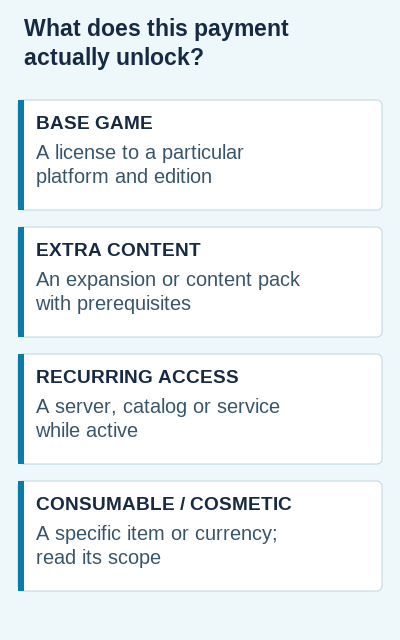
Use three rows headed game access, hosting and content. Game access concerns the relevant Minecraft edition on each participant’s platform. Hosting concerns where the shared world runs and who can join it. Content concerns templates, packs and other Marketplace items. A product may combine rows, but the rows remain different responsibilities. Do not infer that buying one makes every other requirement disappear. Account identity, edition compatibility and platform conditions still need a separate check.
Minecraft’s Marketplace Pass page describes a content subscription for compatible Bedrock installations and distinguishes it from Realms Plus. That official distinction is more useful than comparing subscription names by how premium they sound. Read the current included features and participant limits at checkout; this guide does not freeze them into a permanent price chart. If a bundle contains something you already have, mark that component as already covered rather than counting its advertised value twice.
Treat a template as a starting point, not a hosting service
A world template is attractive when its existing structures or rules save you setup work. Before buying, inspect what the listing actually demonstrates: a map, an adventure, a texture treatment or another kind of pack. Screenshots can show a spectacular location without explaining whether it behaves like an ordinary survival world. Read the product description and any compatibility conditions, then compare those with your project sentence. A content purchase should match the kind of play you want to continue after the opening scene.
Suppose a group wants to extend its own railway over several weekends. A beautiful adventure map may have little value if its scripted objectives are the attraction and the group mainly wants open construction. Another group may welcome exactly that direction because nobody wants to invent a challenge. Neither group has chosen the superior way to play. The useful difference is whether the purchased design replaces work you wanted to avoid or replaces freedom you wanted to keep.
Price the period you will actually use
A subscription invites comparison by monthly cost, while an individual pack invites comparison by its single purchase price. Put them on the same calendar. List the month you expect to start, how long the project is likely to remain active and the point at which you will review renewal. Avoid pretending to know future playtime precisely. A short expected range is more honest than a confident yearly total for a project that has not survived its first session.
Membership access and an individual purchase also have different end conditions. Read the official rules for content leaving a catalogue, membership cancellation and any saved-world access. Do not assume that a downloaded item becomes permanently owned merely because its files are on a device. For an ongoing creative project, the relevant question is what you can continue opening or purchasing after membership ends. Keep that answer beside the price, because continuity may matter more than having a large catalogue this month.
Run a compatibility check before expanding the plan
Ask each participant to identify their actual edition and device. Use the names shown by the installed game and official store, not a remembered console nickname. Then test the simplest available joining arrangement with the people who matter to the project. The purpose is to discover edition, account or permission barriers before spending on extra content. This is a suggested verification task for your group, not a claim that OOZGM has tested your network or accounts.
If the basic connection fails, record the exact symptom and consult the matching official support route. Do not buy a larger content bundle as a speculative fix. A membership can provide the capability it advertises, but it cannot be assumed to repair a wrong account, an incompatible edition or a platform restriction. Keep purchases reversible where possible by deciding only after the required feature is understood. Store refund rules vary; do not use an assumed refund as a substitute for checking eligibility.
Make ownership visible to the group
A shared project becomes fragile when everyone knows the world’s nickname but nobody knows which person controls its subscription or backup. Record the responsible account holder, a renewal review date and a plan for preserving permitted copies of the work. Never place passwords, recovery codes or payment details in a shared planning sheet. The group needs to know who can perform an action, not the credentials that allow impersonation of that person.
Finish with a small purchase decision rather than an open-ended wish list. For example: “We need hosting for this Bedrock project during the next month; we do not currently need extra templates.” Or: “We want this specific adventure pack for solo play and have verified the compatible edition.” Those statements are easy to revisit after actual use. If neither statement fits, keep the project unpaid for now and clarify the missing capability before adding another product to the account.
Minecraft entitlement map
Use a local copy to record the options you have actually checked. Blank cells are for your own observations; this site does not receive your entries.
| Need | Existing access | Proposed purchase | End condition | Responsible person |
|---|---|---|---|---|
| Game access | ||||
| Shared hosting | ||||
| Specific content |
Hypothetical example
A railway group already owns compatible game copies. Its map records hosting as the missing capability and leaves new content unselected.
Download worksheet (CSV)A blank or example-based planning file for your device. OOZGM does not receive what you enter.
Follow the sources
- Official Google Play listing — checked November 15, 2026 ↗
- Minecraft Marketplace Pass: official membership explanation ↗
AI-assisted editorial analysis of public evidence. Suggested workflows and hypothetical cases are not reported device-test results. Report a correction.